Let  with k at least 1. Further, let
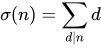
and recall that this function is multiplicative (the sum is over positive divisors of n). Since we are given that n is an even perfect number, we know that
 .
.
Next, we use the multiplicativity of  and see that
 .
.
Since  , we see that
 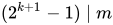 . Let M be an integer such that
  . Substituting this into the above yields
 .
.
Cancelling on both sides yields
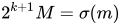 .
.
Using the fact that both m and M are divisors of m (and hence are terms inside the expansion of  , we have that
 .
.
Thus, the greater than sign is in fact an equality. This means that has only two factors, namely m and M. Since  , we must have that
  and so
  . As m has only two prime factors, we also know that
 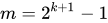 is prime. This completes the proof.
