
Science:Math Exam Resources/Courses/MATH307/April 2010/Question 04 (b)/Solution 1
Knowing has an eigenvalue of 1 we need to solve the equation:

where =


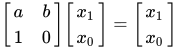
making it into a system of linear equations we get:
1) =


2) =

using 2) we can substitute into 1) so that we are only working with one variable,
=

( )


now that we see how and have to relate, let’s find the other eigenvalue of
solve for either or and input back into and then do our standard


I’m going to continue after having solved for
so our new =


we end up obtaining the equation: ( )


using the quadratic formula with a = , b = and c = , our result is:


,
we knew about the eigenvalue of already,
and so the other eigenvalue of is or, equivalently,
