
Science:Math Exam Resources/Courses/MATH110/December 2013/Question 05 (a)/Solution 1
We evaluate these values by following three steps:
- Reduce the parameter to be in the interval .
- Apply the relevant special triangle, in this case
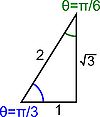
height=500 - Check the sign of the result by remembering the gives the -coordinate and gives the -coordinate.

.
The angle is in the desired interval.
The angle is below the -axis. Applying the special triangle, we get .
We are in the fourth quadrant so the -coordinate is negative.
We have: .
-
The angle is not in the desired interval. So we apply periodicity:
The angle is below the -axis. Applying the special triangle, we get .
We are in the fourth quadrant so the -coordinate is positive.
We have:
.
The angle is not in the desired interval. So we apply periodicity:
The angle is below the -axis. Applying the special triangle, we get .
We are in the fourth quadrant and since , we get that is negative.
Alternative, we can make use of the previous parts to get:
Either way, we have: