The Basic Divergence Detector rejects the series instantly, unless
0 = lim n → ∞ [ c − f ( n ) ] = lim n → ∞ [ c − 1 + ( n + 1 ) e − n ] . {\displaystyle {\begin{aligned}0=\lim _{n\to \infty }[c-f(n)]=\lim _{n\to \infty }[c-1+(n+1)e^{-n}].\end{aligned}}}
We can compute the following limit lim n → ∞ ( n + 1 ) e − n = lim n → ∞ n + 1 e n , {\displaystyle {\begin{aligned}\lim _{n\to \infty }(n+1)e^{-n}=\lim _{n\to \infty }{\frac {n+1}{e^{n}}},\end{aligned}}}
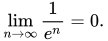
by applying L'Hôpital’s Rule lim n → ∞ 1 e n = 0. {\displaystyle {\begin{aligned}\lim _{n\to \infty }{\frac {1}{e^{n}}}=0.\end{aligned}}}
Then the only way for the following expression to hold true, 0 = lim n → ∞ [ c − 1 ] {\displaystyle {\begin{aligned}0=\lim _{n\to \infty }[c-1]\end{aligned}}} is if c = 1. {\displaystyle c=1.}
![{\displaystyle {\begin{aligned}0=\lim _{n\to \infty }[c-f(n)]=\lim _{n\to \infty }[c-1+(n+1)e^{-n}].\end{aligned}}}](https://wiki.ubc.ca/api/rest_v1/media/math/render/svg/1551ab79b5a11ebad0f91855da1def402bb6b11f)

![{\displaystyle {\begin{aligned}0=\lim _{n\to \infty }[c-1]\end{aligned}}}](https://wiki.ubc.ca/api/rest_v1/media/math/render/svg/8d6301a0432a18968d2cfa9c25f1e614208fb899) is if
is if 
