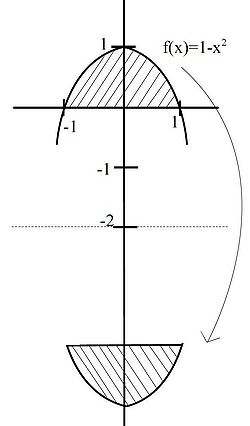
We see the function and a sketch of the volume in the following figure.
We use the shell method
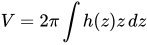
to find the volume. Therefore we need to determine what is the height  and what is the integral variable
  .
.
On the next figure we see, that the height is the inverse of the function

And for this height the integral variable is the distance from  to the rotating axis, which is
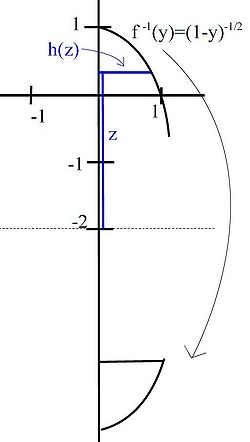
So, we find z = y + 2 and for the height we calculate



For convenience, we calculate half of the volume and drop the left half. Then we can take
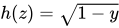
for z = y + 2.
The boundaries of the integral must be the left and right edge of the interval for ![{\displaystyle y=[0,1]}](https://wiki.ubc.ca/api/rest_v1/media/math/render/svg/e83f131298fd965b09ac7dd4b2ed4ec40d750570) . Now we need to calculate the integral
. Now we need to calculate the integral
![{\displaystyle {\begin{aligned}{\frac {1}{2}}V&=2\pi \int h(z)z\,dz\\&=2\pi \int _{0}^{1}(y+2){\sqrt {1-y}}\,dy\\&=2\pi \overbrace {\int _{0}^{1}\underbrace {y} _{=u}\underbrace {\sqrt {1-y}} _{=dv}\,dy} ^{\text{use integration by parts}}+2\pi \int _{0}^{1}2{\sqrt {1-y}}\,dy\\&=2\pi \left[y(1-y)^{\frac {3}{2}}(-{\frac {2}{3}})\right]_{0}^{1}+2\pi {\frac {2}{3}}\int _{0}^{1}(1-y)^{\frac {3}{2}}\,dy+2\pi 2\left[(1-y)^{\frac {3}{2}}\right]_{0}^{1}\\&=0+2\pi {\frac {2}{3}}\left[(1-y)^{\frac {5}{2}}(-{\frac {2}{5}})\right]_{0}^{1}-0+2\pi {\frac {4}{3}}\\&=2\pi {\frac {4}{15}}+2\pi {\frac {4}{3}}\\&={\frac {16\pi }{5}}\end{aligned}}}](https://wiki.ubc.ca/api/rest_v1/media/math/render/svg/9ff7a60fcf618697b98a372cdef803e1bca267ea)
So, we get for the volume


_picture.jpg)
_picture_2.jpg)