
Science:Infinite Series Module/Units/Unit 1/1.1 Infinite Sequences/1.1.08 Example Relating Sequences Absolute Values
Example
Determine whether the sequence
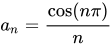
converges.
Complete Solution
We can quickly determine that the sequence converges by noting that
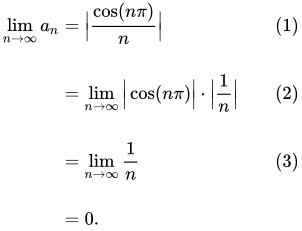
Therefore, by our theorem for the relationship to sequences of absolute values, the given sequence converges.
Explanation of Each Step
Step (1)
In Step (1), we asserted our theorem for the relationship between sequences of absolute values.
Step (2)
In this step, we used a property of absolute values:
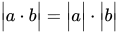
for any real numbers a and b.
Step (3)
Our trigonometric function has the property that , and so


Possible Challenges
Getting Started
It is not always obvious to know which theorem to apply to test for convergence. In this case, we had a specific trigonometric function,

Recognizing that this function takes on values of ±1 gives us a hint that we could try using the relationship to sequences of absolute values, because the absolute value would eliminate the cosine function.
Alternatively, we could have also used the Squeeze Theorem to solve this example, which we explore next.