
Documentation:CHBE Exam Wiki/1.8 - Material Balances
1.8 – Materials Balances
1.8.0 – Learning Objectives
By the end of this section you should be able to:
- Understand the law of conservation of mass.
- Distinguish between the different types of balances.
- Solve a continuous steady-state material balance.
- Solve a batch material balance.
1.8.1 – Introduction
There are certain restrictions imposed by nature that must be considered when designing or analyzing a process. For example, you cannot input 1000 g of lead and output 2000g of lead or gold. Similarly, if you burn 20 kg of wood, you should know that 20 kg of ash and smoke, among other constituents, would be the result of the chemical reaction. The basis of these observations is the law of conservation of mass.
1.8.2 – The Law of Conservation of Mass
The law of conservation of mass states that mass cannot be destroyed or created. This is the crux of 241, its heart and soul. All exercises, exams and (reactor) life is centered around this equation.
We will not be concerned with the almost infinitesimal conversions between mass and energy associated with chemical reactions. This law means that in chemical reactions, the mass of the products will always be equal to the mass of the reactants. This includes anything from fires to acid-base titrations. Therefore, we can use the general balance equation:
The units of the general mass balance are in units per time
1.8.3 – Types of Balances
1. Differential Balances
Differential balances indicate what is happening in a system at an instant of time and are usually used in a continuous process. Each term of the balance is a rate and has units of the quantity per unit time such as . The general mass balance is a differential mass balance.
2. Integral Balances
Integral balances describe what is happening in a system between two instants of time and are usually used in a batch process. Each term of the equation is an amount of the quantity such as .
1.8.4 – Balances on Continuous Steady-State Processes
In continuous steady-state processes, the accumulation term in the general balance equation equals zero,
the equation simplifies to:
If the balance is on a nonreactive process or on total mass, generation, and consumption equal zero and the equation further simplifies to:
1.8.5 – Integral Balances on Batch Processes
Integral balances on batch processes are solved very similarly. Since batch processes don't have continuous inputs and outputs, . Furthermore, the accumulation in the process between and is simply . Therefore
Equating these two expressions yields
1.8.6 – Problem Statement
Problem 1
Question
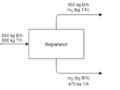
One thousand kilograms per hour of a mixture of benzene (B) and toluene (T) containing 50% benzene by mass is separated by distillation into two fractions. The mass flow rate of benzene in the top stream is 450 kg B/h and that of toluene in the bottom stream is 475 kg T/h. The operation is at steady state. Solve for and
-
 Attribution: Said Zaid-Alkailani & UBC

Answer
Since we know that it is a continuous steady-state non-reactive process, we can use .
1. Toluene Balance
2. Benzene Balance
Problem 2
Question
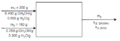
Two methanol-water mixtures are contained in separate flasks. The first mixture contains 40.0 wt% methanol and the second contains 70.0 wt% methanol. If 200 g of the first mixture is combined with 150 g of the second, what are the mass and composition of the product?
-
 Attribution: Said Zaid-Alkailani & UBC

Answer
Since we know this is a batch non-reactive balance, we can use
1. Overall Balance
2. Balance
Finally, we can test if our values are correct with the balance
3. Balance