
Course:LIBR548F/2012WT1/Colophon
Colophon
Definition
The word colophon originates from the Greek κολοϕών or kolophōn, meaning summit, pinnacle, ‘finishing stroke' or ‘crowning touch.’ The later Latin translation is colophon. (OED, 20012; Peters, 1983)
It is the closing statement traditionally included at the end of a book, written by a manuscript's scribe. These often include the title, the name of the scribe, the name of the person who commissioned the copy, location, and date of completion.
"Colophon" is also used to refer to the imprint, printer's mark, publisher's device, or logotype. Some resources cite this as an incorrect use (Glaister, 1996; Peters, 1983), others do not. (Dictionary of Publishing and Printing, 2006; OED, 2012; Beach, 1992; Stevenson, 1968). A possible distinction is that a colophon is used to describe one particular text, while a devise or printer’s mark is used on many different books. (Glaister, 1996)
History
The earliest example of a colophon in a manuscript occurs at the end of a copy of the Books of the Prophets, written in 827 A.D. (Glaister, 1996) Colophons often included a blessing or expression of praise to God, complaints of physical and mental exhaustion after the rigorous process of transcription, and even "threat of excommunication to unauthorized copiers." (Glaister, 1996, p. 103) (Howard, 2009) Colophons were often used to fill up the rest of a page after the text's completion, and could feature enlarged text to achieve that end lest any surface of the valuable velum or paper be wasted. (Glaister, 1996) Earlier writing on tablets also included a colophon of sorts that would reference the next tablet in a sequence of a multi-tablet text. They included a tablet number and the first line of the next tablet. (Elliott & Rose, 2009)
With the advent of printing, the colophon continued to be used, but much of the information contained therein gradually began to appear on the title page, which was used as a wrapping of the printed pages before being bound. (Howard, 2009) They eventually went out of fashion except for in private press publications sometime during the 16th century in favor of the title page. However, technical information such as typeface, paper, and other production notes can sometimes still be found after the text. (Beach, 1992; Stevenson, 1968)
Current Use
A publisher's colophon typically appears on the title page and spine of a book, while the printer's is used on the last page of a text, especially in private press production. (Dictionary of Publishing and Printing, 2006) The colophon has also been used in modern times to note typographical information. (Peters, 1983).
The colophon has experienced a revival in recent years in technical manuals such as those published by O'Reilly Media and even on websites to document their programmatic architecture and the names of contributors. It is essentially a place for metadata about a document's production.
Examples
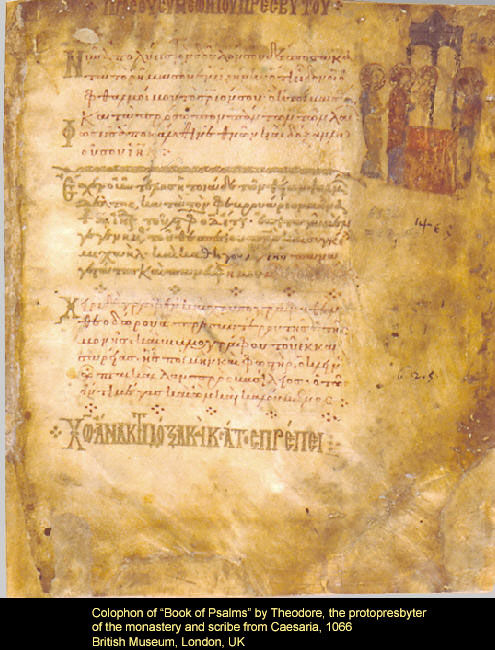
(Pinpush.com) A very early manuscript colophon, circa 1000 A.D.

(Pitt.edu) A private press colophon from 1904.

(Anderson, R.L., photograph of the colophon page of an O’Reilly manual, used with permission)
References
Beach, M., Marcos, S. i., & Galindo, S. (1992). Graphically speaking : An illustrated guide to the working language of design and printing. Manzanita, OR: Elk Ridge Publishing.
colophon, n. (2012). Oxford English dictionary online. Oxford University Press. <http://www.oed.com/view/Entry/36552?isAdvanced=false&result=2&rskey=tO4dr2&>.
colophon. (2006). Dictionary of Publishing and Printing. Retrieved from http://www.credoreference.com/entry/acbpublishing/colophon
Eliot, S. & Rose, J. (eds.). (2009) A Companion to the History of the Book. Hoboken, N.J.: Wiley-Blackwell.
Glaister, G. A. (1996). Encyclopedia of the book (2nd ed.). New Castle, DE: Oak Knoll Press.
Howard, N. (2009). The Book: The Life Story of a Technology. Baltimore: Johns Hopkins University Press.
http://www.library.pitt.edu/libraries/is/enroom/pathfinder/terms.htm#colophon
http://www.pinpush.com/galleries/catalog.htm
Peters. J. (Ed.). (1983). The bookman's glossary. (6th ed.). New York, NY: R.R. Bowker Co.
Stevenson, G. A. (1968). Graphic arts encyclopedia. New York, NY: McGraw Hill.