
Course:CSIS200/2024/The Leather Jacket: Identity, Rebellion, and Evolution in Heavy Metal Subgenres
About me
Hi, my name is Victor Abu Ghazaleh! I'm a second-year student studying business UBC. As a long-time musician and a relatively new "metalhead," I chose this project because perspectives on metal often vary widely: some associate it with negative stereotypes, while others see it as a rich, diverse, and evolving community. Despite this, conflicts persist within the metal scene, particularly between older and newer generations. I was drawn to the topic of leather jackets and their varied interpretations because they encapsulate both the unity and tensions within the genre. This project allowed me to delve deeper into the history, subcultures, and shifting identity of a community I’ve recently become part of, offering me a greater appreciation for its complexity and diversity.
Introduction
The leather jacket stands as an enduring symbol and cultural artifact within heavy metal, emblematic of the rebellious spirit and strong sense of individuality that many perceive the genre to cultivate. Heavy metal artists and fans have redefined the leather jacket, drawing from the rugged style of biker gangs and the provocative influence of S&M subcultures, especially in U.S. alternative and hardcore subgenres since the 1980s. More than a mere fashion statement, the leather jacket is a cultural artifact that has conveyed diverse messages about identity, resistance, and community.
In Critical Sexuality Studies, the leather jacket acts as a "queerscape," a visual tool for challenging normative societal expectations. Scholars like Heesch and Scott (2020)[1] argue that heavy metal contains overlapping subcultures, with leather jackets acting as both a marker of inclusion and rebellion. While often perceived as hypermasculine, the leather jacket’s ties to queer subcultures complicate this narrative, subverting traditional gender roles and fostering inclusivity within the genre.
This essay argues that the leather jacket encapsulates identity and rebellion in heavy metal, reflecting themes such as power dynamics, class distinctions, and gender fluidity, while adapting to different subgenre-specific meanings and global cultural shifts. By examining examples such as Rob Halford’s leather-clad persona and fan adaptations of the jacket, we see how it functions as a personal and collective symbol. It becomes a canvas for expressing resistance, articulating identity, and finding belonging in a world that often marginalizes alternative expressions of self.
The Historical Roots of the Leather Jacket
The leather jacket’s evolution into a cultural symbol of heavy metal stems from diverse historical roots, spanning military, biker, and queer subcultures. Originally designed for practicality, leather jackets were first popularized in the U.S. Army in the early 1900s. During World War II, military pilots wore leather jackets, which came to symbolize resilience and heroism. These associations laid the foundation for the jacket’s rugged and commanding image, later embraced by biker gangs in the mid-20th century.[2]
In biker culture, the leather jacket transcended its functional origins to become an emblem of rebellion and solidarity. Figures like Marlon Brando in The Wild One immortalized the leather jacket as a symbol of defiance and individuality, tying it to the outlaw ethos of motorcycle gangs.[3] These representations also carried subtle queer undertones, as the hypermasculinity of biker aesthetics overlapped with imagery celebrated in queer subcultures.
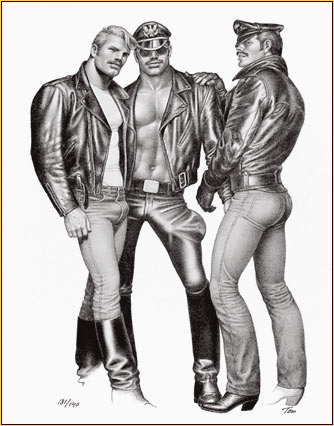
Simultaneously, the leather jacket gained prominence in the queer leather fetish scene, celebrated in works like Tom of Finland’s Leather Brotherhood (shown below). These depictions transformed the leather jacket into a symbol of sexual liberation and camaraderie, subverting traditional notions of masculinity while emphasizing identity and power within LGBTQ+ communities.
The fusion of these influences paved the way for the leather jacket’s adoption into heavy metal, with Judas Priest playing a pivotal role in popularizing its iconic image. Rob Halford noted in Confess (2020)[5] that guitarist K.K. Downing suggested the leather look to create a tougher, unified image. While not intentionally drawing from queer subcultures, Halford’s leather styles coincided with elements from queer spaces, inadvertently echoing their symbolism. However, Halford clarified that his stage attire was not reflective of personal interest in S&M or domination, stating, “I had no interest in S&M, domination or the whole queer subcult of leather and chains... I was — and still am — pretty vanilla” (p. 152). This highlights how the leather aesthetic was embraced as a powerful visual statement rather than a direct commentary on Halford's personal identity.

However, fans often misinterpreted the leather-clad look as a purely hypermasculine, biker-inspired aesthetic, aligning with the genre’s dominant image. As Walser (1993)[7] argues, heavy metal culture has historically "reframed or ignored elements that challenge its heteronormative masculinity," offering opportunities for fans to "experience confirmation and alteration of their gendered identities" (p. 108). The selective reinterpretation of cultural symbols meant that queer-coded aspects of the leather aesthetic were largely overlooked or absorbed into the genre’s hegemonic framework. Despite this misreading, the leather jacket became a cornerstone of heavy metal’s visual language, embodying rebellion, strength, and individuality.
The signaling function of leather jackets in heavy metal somewhat parallels the Hanky Code in queer subcultures, where specific symbols discreetly communicated affiliations or personal preferences. Similarly, jackets in metal subcultures serve as visual markers, signaling one’s musical tastes, political leanings, or values. Whether through DIY patches or intricate embroidery, these choices often function as an invitation for like-minded individuals while simultaneously setting boundaries for others.
Leather Jackets and Masculinity in Metal
It is no surprise that heavy metal has been a hypermasculine and male-dominated genre, with the leather jacket illustrating this domination. Leigh Krenske and McKay’s Hard and Heavy: Gender and Power in a Heavy Metal Music Subculture[8] highlights how symbols like leather jackets reinforce stereotypical masculinity, creating a space where women’s participation is marginalized. Their ethnographic research highlights how symbols like leather jackets and other aggressive elements of the subculture have historically been tied to male dominance, creating an environment where women’s participation is often limited or overlooked despite their presence and contributions. This “macho” image has perpetuated exclusionary practices that define authenticity within the scene, prioritizing power and toughness over diversity.[9]
Although the leather jacket reinforces these hypermasculine ideals, it can also provide opportunities for personal expression. Fan-created designs (image linked here[10]), featuring personalized patches, slogans, and modifications, allow wearers to personalize and reinterpret their jacket's meaning and message. These individual adaptations challenge its traditional associations with hypermasculinity, introducing alternative narratives into a symbol deeply tied to exclusionary norms.


Rob Halford’s coming out as gay in 1998 further disrupted the traditional view of masculinity in metal for many. As Judas Priest’s frontman, Halford's leather-dressed appearance epitomized metal’s tough and “macho” aesthetic while also challenging its heteronormative expectations. With over 50 million album sales and eleven records reaching the UK Top 30 during the group's active years, it’s safe to say that his revelation was embraced by a significant portion of the community. Halford’s openness has since paved the way for more inclusive attitudes within heavy metal, illustrating how the leather jacket can symbolize defiance in ways beyond traditional masculinity.[12]
Modern bands like SeeYouSpaceCowboy and the HIRS Collective exemplify how heavy metal and its overlapping subgenres, such as hardcore, are evolving to embrace diversity. With its DIY ethos and anti-establishment stance, the hardcore scene has increasingly fostered inclusivity. This ethos is reflected in the music and the subculture’s fashion, where customized battle jackets, featuring patches and personal designs, serve as a symbol of individuality and rebellion, often alongside or as an alternative to leather jackets. The vibrant aesthetic and raw energy of SeeYouSpaceCowboy’s music video for Misinterpreting Constellations visually capture this inclusivity, blending bold colors and nostalgic 2000s vibes with an intense, unapologetic performance that challenges traditional notions of masculinity.
Music Video[13]
Frontwoman Connie Sgarbossa, one of the few openly trans front people in a signed band, exemplifies this spirit, breaking significant ground in an industry still grappling with inclusivity. The band’s combination of raw intensity and queer themes redefines what it means to belong within heavy metal.[14]
As the genre diversifies and becomes more globally influenced, its symbols, like the leather jacket, are reinterpreted to align with contemporary values of inclusivity and individuality.
Leather Jackets Across Subgenres
The battle jacket, whether made of leather or denim, is an integral part of heavy metal culture, embodying personal expression and community affiliation. Fans transform these jackets into "battle jackets" by customizing them with patches, studs, and artwork that showcase their favorite bands and their identities. Historically, the aesthetic of battle jackets highlighted a stark divide between punk and metal. Punk jackets leaned into DIY rawness, with screen-printed patches and rough stitching, reflecting a rebellious ethos. Metal jackets, on the other hand, favored cleaner embroidery and brighter designs, emphasizing strength and unity. Despite these differences, the jackets in both cultures served as invitations into their respective communities, signaling shared values and affiliations.
The leather jacket’s meaning shifts significantly across heavy metal subgenres, reflecting their distinct aesthetics, cultural values, and ongoing controversies.
Black Metal: Power, Mystique, and Controversy
In black metal, the battle jacket often takes the form of black leather, aligning with the subgenre’s emphasis on minimalism, mystique, and raw power. This uniformity reinforces the genre’s rejection of mainstream embellishment, aligning with its roots in rebellion and extremity. However, the black metal scene is not without its controversies. Highlighted by Will J. in On the Racism Problem in Black Metal (2021)[15], this subgenre is plagued by associations with racism, nationalism, and other discriminatory ideologies. These issues persist despite the presence of more inclusive modern bands like Gorgoroth and Zeal & Ardor, who actively challenge these regressive attitudes.[16]
The leather jacket, as a symbol of power and rebellion, is often entangled in these contradictions, both reinforcing traditional ideals and serving as a marker of resistance against mainstream culture. The patches on black metal battle jackets can highlight these tensions, some may perpetuate problematic ideals, while others promote progressive messages that challenge the status quo.
Thrash Metal: Defiance Through Style
Thrash metal’s battle jackets, often made of denim, stand as a hallmark of the genre’s distinct, anti-glam aesthetic. Overall, it can be considered as metals most recognizable style. Rooted in the DIY ethos of punk, thrash fans customize their jackets with patches from iconic bands such as Metallica, Slayer, and Megadeath. The battle jacket was part of a larger thrash style that rejected the excesses of 1980s glam rock. This rejection also extended to the adoption of military-inspired accessories, such as bullet belts, which added a layer of aggressive imagery. While purely aesthetic, these belts became synonymous with thrash’s gritty, confrontational image. Nike high-tops, an unexpected staple in thrash fashion, were popularized by bands like Megadeth, with frontman Dave Mustaine recalling how record labels often provided them as part of early contracts.
Hardcore: Political Messages and DIY

Originating in the late 1970s as an offshoot of punk rock, hardcore is characterized by its faster tempos, raw sound, and emphasis on anti-establishment values. In this subgenre, the battle jacket serves as a potent symbol of the movement’s DIY ethos and political activism. Hardcore fans customize their jackets with patches, slogans, and artwork that reflect their personal beliefs and musical affiliations, often addressing societal issues such as inequality, environmental concerns, and anti-authoritarianism. The term "hardcore" became a foundational label, spawning numerous subgenres that adopted "core" in their names, such as emocore, metalcore, grindcore, and fastcore, to indicate their roots in the punk and hardcore traditions.[18] The influence of hardcore has given rise to numerous subgenres, each with its own fashion trends and twists on the battle jacket.
Sasscore, blending post-hardcore, screamo, and influences like disco and metalcore, emerged in the early 2000s as a flamboyant counter to hypermasculinity in hardcore.[19] Known for its effeminate vocals and irreverent aesthetic, sasscore challenges conventions with colorful, androgynous fashion and homoerotic undertones, as seen in bands like SeeYouSpaceCowboy and The Blood Brothers. While battle jackets are less common in this niche subgenre, fans who wear them often use denim jackets adorned with vibrant patches, progressive symbols, and playful designs that reflect sasscore’s celebration of individuality and defiance against rigid norms.[20]
Queercore, a subgenre born in the 1980s to challenge exclusion in both punk and LGBTQ+ spaces, uses music and fashion as tools of defiance. Fans often customize battle jackets with slogans, symbols, and artwork that promote queer liberation and confront societal norms. Bands like G.L.O.S.S. and The HIRS Collective embody this ethos, blending radical messaging with personal expression.[21] Queercore battle jackets, as depicted in this image[22], are vibrant and unapologetic, reflecting the subgenre’s focus on empowerment and solidarity.
Class and Accessibility in Metal Culture
Despite the leather jacket being one of the most recognizable and desired pieces in heavy metal fashion, its high cost often ties it to class privilege, limiting accessibility for fans from lower socioeconomic backgrounds. Paula Rowe’s Global Metal in Local Contexts (2017)[23] research highlights how class structures shape participation within metal subcultures, where expensive leather jackets could be perceived as markers of authenticity. At the same time, their high price point can alienate some fans, as the jacket may be seen as a signifier of wealth or privilege that contradicts metal’s working-class roots. Subgenres like black metal reinforce this association, emphasizing stark, minimalist leather aesthetics that align with exclusivity and a sense of elite belonging.
However, heavy metal culture’s growing DIY ethos has provided alternatives for those who cannot afford the traditional leather jackets. Denim, faux leather, and military jackets are often much more accessible with lower price points, allowing fans participate in the aesthetic without the financial burden. DIY customization plays a crucial role, allowing fans to personalize their battle jackets, hoodies, and cargo pants with patches, studs, and designs that showcase their musical interests and individual identities. This image[24] illustrates a fan-made hoodie that emphasize creativity over material cost, showcasing how accessible alternatives preserve the rebellious ethos of the genre.
This shift in metal fashion is mirrored by the growing influence of punk politics within the genre, particularly in grindcore. Bands like Napalm Death and Cattle Decapitation have brought vegan and anarchist ideals into spaces once dominated by traditional notions of rebellion. These developments highlight how metal continues to evolve, incorporating progressive values while maintaining its anti-establishment ethos.
Rowe’s analysis raises further questions about the tensions some in the metal community may have between class and authenticity. While traditionalists may view leather as the hallmark of “true” metal identity, these perceptions have been consistently challenged by younger fans who adapt the aesthetic to their means. As seen in Reddit discussions and fan commentary, younger generations (especially in the hardcore community) incorporate a variety of materials and styles, proving that dedication to the music often outweighs the materiality of their fashion choices. This adaptability ensures that heavy metal remains inclusive, allowing fans from diverse backgrounds to participate fully in its culture.
Modern Adaptations and Trends
As heavy metal continues to evolve, its fashion reflects the genre’s ability to adapt while retaining its rebellious core. While leather jackets remain a staple, modern fans have redefined metal attire by incorporating black denim jackets, band hoodies, cargo pants, and sneakers such as Vans or Jordans into their wardrobes. This shift highlights a blend of tradition, practicality, and personal style, much like punk’s earlier shift toward camo jackets and patch pants. Newer trends, such as the resurgence of nu-metal-inspired styles, introduce elements like baggy jeans, graphic tees, and chunky shoes, reflecting broader cultural influences. Artists like Poppy, who blend trap, metalcore, and pop aesthetics, exemplify how modern subgenres adopt metal’s visual intensity while incorporating trends like hip-hop-inspired streetwear. These evolving choices emphasize not only affordability but also a growing focus on individuality and inclusivity, mirroring the blending of punk's ethics into grindcore and other subgenres.

Conclusion
The leather jacket is more than a fashion piece; it’s a canvas for rebellion, identity, and community within heavy metal. Its adoption and adaptation across subgenres underscore the genre’s dynamic and inclusive evolution, maintaining its legacy as a marker of resistance and individuality.
References
- ↑ Heesch, F., & Scott, N. (2016). Heavy metal, gender and sexuality: Interdisciplinary approaches (1st ed.). Routledge. https://doi.org/10.4324/9781315586458
- ↑ Buffalo Jackson. (n.d.). The history of leather jackets. Buffalo Jackson Trading Co. https://buffalojackson.com/blogs/insight/history-of-leather-jackets#:~:text=The%20leather%20jacket%20was%20born,were%20open%2Dair%20and%20uninsulated.
- ↑ Los Angeles Times. (2024, March 27). The photo that wrapped Marlon Brando's homoerotic appeal around the world. Los Angeles Times. https://www.latimes.com/opinion/story/2024-03-27/how-one-photo-of-marlon-brando-turned-us-all-a-little-gay
- ↑ Tom of Finland. (1980). The Leather Brotherhood [Drawing]. Erotic Art Collection. https://www.eroticartcollection.com/Tom_of_Finland/Tom_of_Finland_15.html
- ↑ Halford, R. (2020). Confess: The autobiography. Headline Publishing Group.
- ↑ Damron, B. (1980). Color codes from Bob Damron’s address book [Image]. The Saint Foundation. https://www.thesaintfoundation.org/community/hanky-code-bob-damrons-address-book
- ↑ Walser, R. (2015). Running with the devil: Power, gender, and madness in heavy metal music (New ed.). Wesleyan University Press. https://muse.jhu.edu/book/23384
- ↑ Krenske, L., & McKay, J. (2000). Hard and heavy: Gender and power in a heavy metal music subculture. Gender, Place and Culture, 7(3), 287-304. https://doi.org/10.1080/713668874
- ↑ Laite, J. (2014, April 8). Beards, Real Men, and Poseurs: Male Sexuality and Fashion Since Around 1900. Notches: (re)marks on the history of sexuality. https://notchesblog.com/2014/04/08/if-you-have-a-beard-you-better-k-women-male-sexuality-fashion-and-the-patriarchy-c-1885-present/
- ↑ Reddit User "[Madi_Danger]." (2023, September 18). Some of my DIY leather jackets. Reddit. https://www.reddit.com/r/BattleJackets/comments/16m66wr/some_of_my_diy_leather_jackets/
- ↑ Petersen, Z. (2005, October 2). Judas Priest members performing during the Retribution 2005 Tour, showcasing their iconic studded leather outfits [Photograph]. Flickr. https://www.flickr.com/photos/e53/49148368/in/set-1067492/
- ↑ Dalton, S. (2020, September 29). Rob Halford: “If I wanted some action on the road, how the hell was I supposed to go about it?” Louder. https://www.loudersound.com/features/rob-halford-if-i-wanted-some-action-on-the-road-how-the-hell-was-i-supposed-to-go-about-it
- ↑ Pure Noise Records. (2021, September 21). SeeYouSpaceCowboy "Misinterpreting Constellations" (Official music video) [Video]. YouTube. https://www.youtube.com/watch?v=XTYcP9sOd94
- ↑ Senior, N. (2024, April 30). Interview: Connie Sgarbossa of SeeYouSpaceCowboy talks 'Coup de Grace'. New Noise Magazine. https://newnoisemagazine.com/interviews/interview-connie-sgarbossa-of-seeyouspacecowboy-talks-coup-de-grace/
- ↑ J., Will. (2021, June 17). On the Racism Problem in Black Metal. The Sleeping Shaman. https://www.thesleepingshaman.com/articles/racism-black-metal/
- ↑ Stuen, E. A. W. (2020, May 27). Changing masculinity in Norwegian black metal. Kilden. https://kjonnsforskning.no/en/2020/05/changing-masculinity-norwegian-black-metal
- ↑ Devinandcraig. (2023, June 23). Members of Soul Glo, Pierce Jordan, TJ Stevenson, and GG Guerra (from left to right) [Photograph]. Wikimedia Commons.
- ↑ Breathing The Core. (n.d.). Genres & subgenres. https://www.breathingthecore.com/p/genres-subgenres.html
- ↑ What is Sasscore? A Genre Field Guide. (2024, June 11). WKNC 88.1 FM Raleigh. https://wknc.org/2024/06/11/what-is-sasscore-a-genre-field-guide/
- ↑ _pipes. (n.d.). Compendium of sass: AKA what was it like to be a cool person in hardcore 10–15 years ago? Rate Your Music. https://rateyourmusic.com/list/_pipes/compendium_of_sass___aka_what_was_it_like_to_be_a_cool_person_in_hardcore_10_15_years_ago_the_historiography_of_sass/
- ↑ Ivy, J. (2022, January 6). Queercore: What is it? And six bands you should listen to. For the Punks. https://ftpunks.com/queercore-what-is-it-and-six-bands-you-should-listen-to/
- ↑ Reddit User "DaniTheDeer" (2021, December 9). My first jacket! A mess of riot grrrl, queercore and folkpunk, but I love it! Reddit. https://www.reddit.com/r/BattleJackets/comments/kle6ck/first_leather_jacket/
- ↑ Rowe, P. (2017). Global metal in local contexts: Questions of class and the structuring of early heavy metal identity formations. Metal Music Studies, 3(1), 113-133. Intellect Ltd. https://doi.org/10.1386/mms.3.1.113_1
- ↑ Reddit User "Creative-Advantage58." (2023, May 2). Patch hoodie I'm working on + some patches I still have to add to it. Reddit. https://www.reddit.com/r/BattleJackets/comments/135s96t/patch_hoodie_im_working_on_some_patches_i_still/
- ↑ Earthworm. (2008, December 22). Black leather jacket with LGBTQ+ buttons, documenting queer history and activism [Photograph]. Flickr. https://www.flickr.com/photos/e53/49148368/